





Designing resilient cities: a guide to good practice (EP 103)
BRE (Building Research Establishment) is an independent, research-based consultancy, testing and training organisation, operating in the built environment and associated industries.
On 11 April 2012 BRE published Designing resilient cities: a guide to good practice (EP 103) by DR Lombardi, JM Leach and CDF Rogers (University of Birmingham) and the Urban Futures Team.
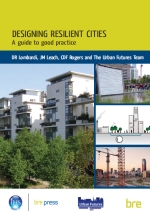
Global urbanisation is increasing dramatically and most of the world’s population now lives in cities, making urban sustainability a top priority. Designing resilience is about putting in place solutions that are resistant to future uncertainties. Large investments are being made today to make our cities more sustainable; the success of these investments depends on their resilience and how the future develops.
The 126-page BRE guide presents the Urban Futures Method for testing the likely future performance of urban developments and regeneration-related sustainability solutions (actions taken today in the name of sustainability) in a series of possible future scenarios in the year 2050. If a proposed solution delivers a positive legacy, regardless of the future against which it is tested, then it can be adopted with confidence.
The method was developed as result of a four-year, £3.1 million grant from the UK Engineering and Physical Sciences Research Council on Urban Futures, and was directed by a steering committee and expert panellists representing industry, government, academia and the third sector. It provides insights into the potential impacts of today’s urban planning and design decisions, and challenges the conventional mainstream approach to sustainability by incorporating changing priorities and different ways of thinking into today’s actions.
The contents of the guide are:
- Abbreviations and glossary; Executive summary.
- Part One: Introduction to the Urban Futures Method.
- Part Two: The Urban Futures Method: delving more deeply.
- Part Three: worked examples of sustainability solution-benefit pairs.
[edit] Related articles on Designing Buildings
- BRE articles on Designing Buildings Wiki
- BREEAM Designing for durability and resilience.
- Building flood resilience.
- Building research establishment.
- Design flexibility.
- Engineering in the 21st century.
- Engineering resilience to human threats.
- Environmental plan for building design and construction.
- Future proofing construction.
- Helping communities recover from disasters and protecting them before they occur.
- Managing and responding to disaster.
- Property flood resilience.
- Resilience.
- Resilient infrastructure diversity and equity scorecard.
- Risk assessment.
- Sustainability in building design and construction.
- Two steps towards a more resilient world.
Featured articles
Check out some of the best features and news from Designing Buildings as well as key stories from around the web.

CIOB celebrates positive Ofsted report.

The Building Safety Regulator announces a call for evidence.

Government approach could undermine delivery and regeneration.
World's first mass timber data centre.

The overlooked environmental aspect of data centre development.
Introduction to radon awareness

New technical information sheet published by CIOB.

Updated supplier guide can help electrical contractors engage with NHP.

CIAT confirm the winners of the 2026 architectural technology awards.

Government launches a one stop shop for flood preparedness.

Sir Edwin Lutyens: Britain's greatest architect? Book review.

CIOB publishes free template to help assess and manage risks.
ECA's reflections on Party Conference season

Burnham wants to be confident of winning before asking for a fresh mandate.
New Chief Construction and Scientific Adviser

Sergio Cavalaro, Professor of Infrastructure Systems at Loughborough University.